Flagship projects, shown as decisions rather than screenshots — the context each one started from, the reasoning behind it and the system it became.
01
Independent product
SoyMaistro
From text to estimate.
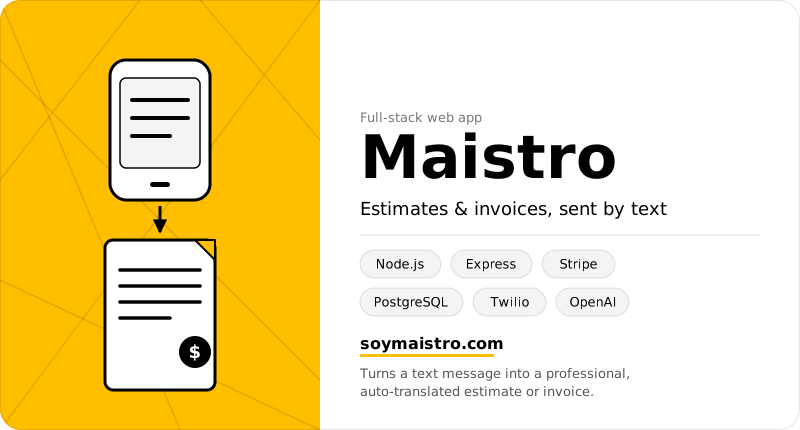
Describe the job in a text. SoyMaistro turns it into a professional estimate or invoice — structured, ready to send and connected to the tools needed to follow through.
Role Product strategy / UX and workflow design / AI implementation / Full-stack development / Stripe, Twilio and Mailchimp integrations
For independent contractors and service businesses, finishing the work is often faster than doing the paperwork behind it. Job details start as texts, rough notes or conversations — not structured documents.
Problem
Turning that information into a professional estimate or invoice requires additional time, formatting and repetitive data entry — work that competes with the next job.
Insight
The job description already exists, in a text message or a few rough lines. The estimate should be generated from that, not rebuilt from scratch.
Product
An AI-powered workflow that converts a plain-language description of a job into a structured estimate or invoice — organized into line items, descriptions and pricing, ready for the user to review and send.
System
Stripe supports payment collection, Twilio connects customer messaging and Mailchimp enables email communication and follow-up — extending the product beyond document generation into a connected customer workflow.
Outcome
Reduced the distance between describing a job and getting paid. A contractor can move from an informal text to a professional business document in one streamlined process, without switching between disconnected tools.
SoyMaistro — estimates and invoices, sent by text
02
AI Research / Data Enrichment / Outreach Automation
Hidalgo Lead Intelligence Platform
A lead-intelligence system that transforms large commercial real estate datasets into researched contacts and personalized outreach opportunities.
Role Product design / Workflow architecture / AI research automation / Data enrichment / Email verification / Outreach generation
Context
Commercial real estate exports provided hundreds of potentially useful property and company records — but the raw data stopped at names and addresses, not who to actually contact.
Problem
The underlying data did not identify the best person to contact or provide enough context for meaningful outreach. Researching companies, locating likely decision-makers, verifying contact information and drafting emails manually made the data difficult to act on at scale.
Insight
The dataset wasn’t short on leads — it was short on the research that turns a record into a reason to reach out.
Product
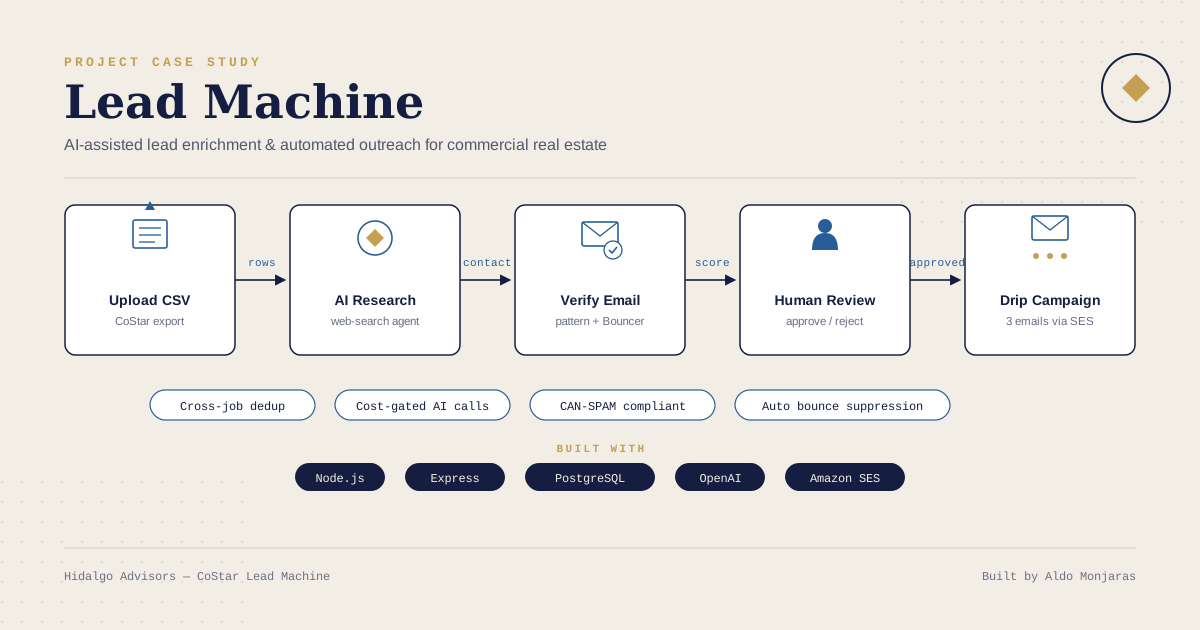
An automated enrichment pipeline that ingests raw records, researches each company through AI-assisted web browsing, identifies the most probable decision-maker and assembles supporting contact information.
System
The system verified email addresses and generated personalized outreach drafts based on the company, property and identified opportunity — turning static rows of data into a ready-to-review pipeline.
Outcome
Converted a static spreadsheet into an actionable business-development pipeline. The platform reduced repetitive research and email preparation while giving each lead more context, a probable contact and a ready-to-review outreach message.
Lead Machine — AI-assisted lead enrichment and outreach pipeline for Hidalgo Advisors
03
Field Operations / Workflow Automation
Field Reporting Platform
A mobile-first reporting tool that turned field photos and observations into consistent, professionally formatted reports in minutes.
Role Product definition / Workflow design / User experience / Application development / Report generation
Context
Technical staff documented site conditions the same way for every job: photograph the site, then rebuild that information into a formatted report back at the office.
Problem
Site documentation depended on manually organizing numerous photographs, writing repetitive descriptions and formatting each report from scratch. The process took time, produced inconsistent results and pulled technical staff away from higher-value work.
Insight
The bottleneck wasn’t the fieldwork — it was the gap between collecting information on-site and turning it into something presentable afterward.
Product
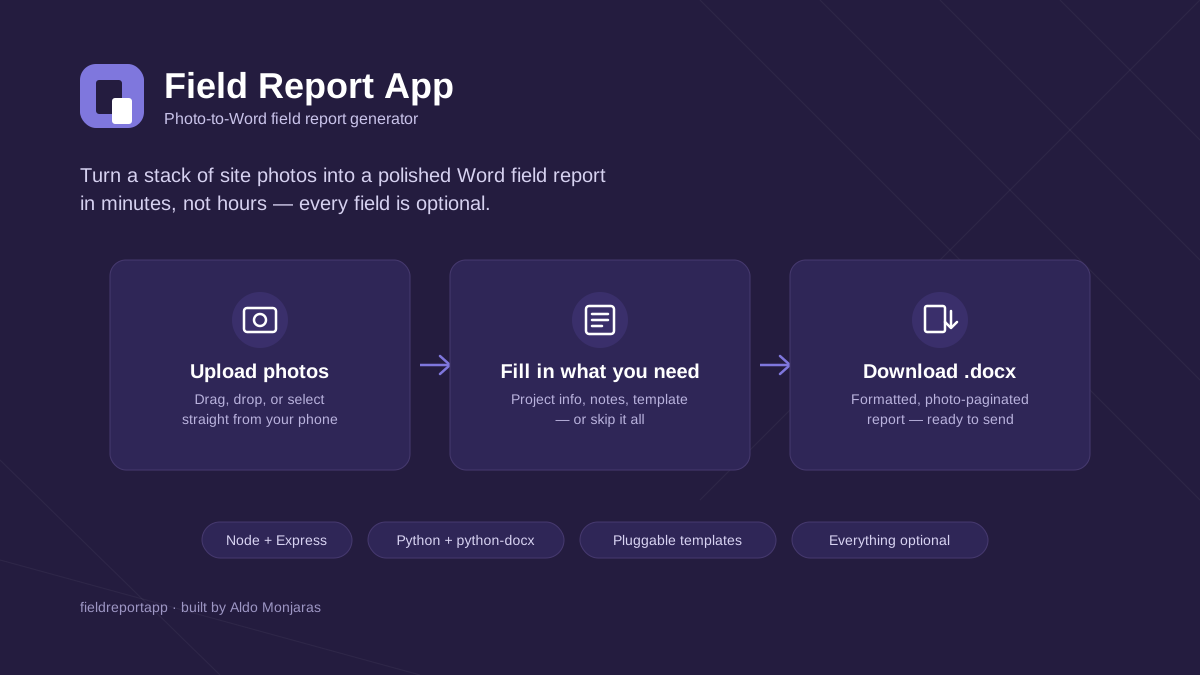
A streamlined application for uploading field photos and adding structured observations directly from the field, without a detour through separate reporting software.
System
The application automatically assembled photos and observations into a standardized report — a workflow designed around how field staff actually collected and communicated site conditions.
Outcome
Created a faster and more repeatable reporting process while improving consistency across field documentation. The application demonstrated how a focused internal tool could remove administrative work without changing the underlying field process.
Field Report App — photo-to-Word field report generator
02 / How I work
Technology should fit the operation.
Not the other way around. Every project moves through the same five stages, whether the output is a mobile app, an internal tool or an AI-assisted workflow.
01
Understand
Learn the workflow, the constraints and the people who depend on it.
02
Define
Frame the real problem and decide what is actually worth building.
03
Design
Shape the product and the system around how the work actually happens.
04
Build
Ship working software — web, mobile, data, integrations and applied AI.
05
Improve
Measure against the workflow and refine whatever doesn’t hold up.
Field tools / Project information / Enterprise workflows
04 / Perspective
How I think about this work.
Short, occasional notes on product, operations and applied AI — published as they’re written.
01
Essay in progress
Notes on this topic are being written and will be published here soon.
02
Essay in progress
Notes on this topic are being written and will be published here soon.
03
Essay in progress
Notes on this topic are being written and will be published here soon.
05 / About
Between engineering, product and the field.
I am a product builder and software developer who works at the intersection of technology and real operations. I take complicated workflows, define what a useful solution should do, and build the software or systems to make it real.
My background sits between software engineering, product development and complex physical operations. I started building software inside environments where information moves between offices, project teams and the field. That shaped how I approach technology: understand the operation first, then build the system around it.
06 / Contact
Have a difficult workflow or product problem? Let’s make it understandable — then make it work.